
China to Korea Shipping Guide
China to Korea
Customs Clearance Guide:
Export Declaration to
Import Release
Shipping from China to Korea can be fast. The delays usually come from documents, not distance. This guide explains how to prepare the cargo, export declaration and Korea-side import clearance before the shipment gets stuck.

Useful for factories, ecommerce buyers, small wholesalers and purchasing teams managing several suppliers.
Supplier pickup planning, warehouse receiving, carton check, consolidation, export document review and shipping coordination.
Korea import declaration normally needs the importer or appointed Korea customs broker to confirm local requirements.
This guide explains how China to Korea customs clearance works in real operations. It covers the export side in China, the import side in Korea, the documents importers should prepare, and a practical case showing how Hamjing helped a Korean customer move goods from several Chinese suppliers into one cleaner shipment plan.
The purpose is not to make customs sound complicated. The purpose is to show what has to be checked before booking, so the importer knows exactly what Hamjing does and where the Korea-side broker still needs to be involved.
Why China to Korea Shipping Still Needs Customs Planning
China and Korea are close trading partners. For many products, transit time can be short and sailings are frequent. That is why importers sometimes treat the route as a simple domestic-style delivery: supplier pickup, port, vessel, arrival, delivery.
In practice, international shipping is not only transport. It is also a customs process on both sides.
For export from China, the cargo must be declared before it leaves the country. The forwarder or customs broker needs accurate product information, invoice value, packing list data, HS code, exporter details and transport information.
For import into Korea, the Korean importer or customs broker files the import declaration. Korea Customs Service describes import clearance as the procedure that allows imported goods to be released after declaration and customs acceptance. Korea import declarations are handled through the UNI-PASS electronic clearance system.
A practical China to Korea route therefore looks like this:
Cargo ready, packing list prepared.
Receive, count, measure, consolidate.
Declaration, inspection if selected, release.
Sea freight or air freight to Korea.
Import declaration, duties, VAT, release.
Warehouse, 3PL, business address or FBA prep route.
Step 1: Confirm the Korean Importer Before Pickup
Before the cargo leaves the supplier, the first question is not the freight rate. The first question is: who will act as the importer in Korea?
When a Korean customer contacts Hamjing, we first separate the China-side work from the Korea-side customs responsibility. This sounds basic, but it prevents a common problem: the cargo is already on the way, but nobody has confirmed who can legally declare it in Korea.
At this stage, Hamjing confirms:
- Who is the importer of record in Korea?
- Has the Korean importer appointed a customs broker?
- Is the destination Busan port, Incheon airport, a business warehouse, a 3PL or another address?
- Which Incoterm applies: EXW, FOB, CIF, DAP, DDP or another term?
- Who is responsible for Korea import duty, VAT, local terminal handling and final delivery coordination?
This is important because a China freight forwarder can coordinate China pickup, warehouse handling, export declaration and international shipping, but Korea import declaration normally needs the Korean importer or a Korea-side customs broker. If the buyer asks for door-to-door service, responsibilities must be mapped before booking, not after the vessel arrives.
In practice, Hamjing will ask the customer for the Korea broker contact early. If the customer already has one, we send the draft invoice, packing list and transport plan for pre-check. If the customer does not have one, we tell them what information the Korea-side broker will normally need so they can prepare internally.
Step 2: Collect Accurate Cargo Details From the Supplier
A useful shipment plan and a clean customs declaration both begin with real cargo information. “Ten cartons ready” is not enough.
For a China to Korea shipment, Hamjing normally asks for the following details before arranging pickup:
- Product name and material
- Product use
- HS code if available
- Carton quantity
- Carton dimensions
- Gross weight and net weight
- Total CBM
- Supplier name and pickup address
- Cargo ready date
- Shipping mark or customer reference
- Invoice value
- Korea delivery address
- Preferred shipping method
The product description should be specific. “Accessories” is too vague. “Plastic phone case” is better. “Plastic phone case, non-branded, for mobile phone protection” is clearer for document review.
This is also where Hamjing checks whether the goods may need extra attention before export: batteries, liquids, magnets, cosmetics, food contact goods, children’s products, branded goods, chemicals and electronic products can all require closer document review. We do not guess from the product photo alone. We ask for material, function, product link or catalog information when the product name is not enough.
Step 3: Receive Cargo at the China Warehouse
If there is one supplier and a full container, cargo may go directly from factory to port. But many Korea shipments involve small-volume goods, sample orders, ecommerce inventory, or purchases from multiple suppliers. In those cases, the forwarder warehouse becomes the control point.
When cargo arrives at the warehouse, Hamjing checks the shipping basics:
- Whether the cartons arrived
- Supplier name and customer reference
- Carton count
- Outer carton condition
- Shipping marks
- Dimensions and weight if needed
- Photos for customer confirmation
After receiving, Hamjing sends the customer a short warehouse update instead of waiting until everything is booked. A typical update includes supplier name, received carton count, visible carton condition, measurement status, missing information and the next action.
This is not the same as a product quality inspection. Warehouse receiving confirms shipping data. It does not automatically open cartons, test product function, verify color, or count units inside every carton. If product inspection is needed, it should be arranged separately before export.
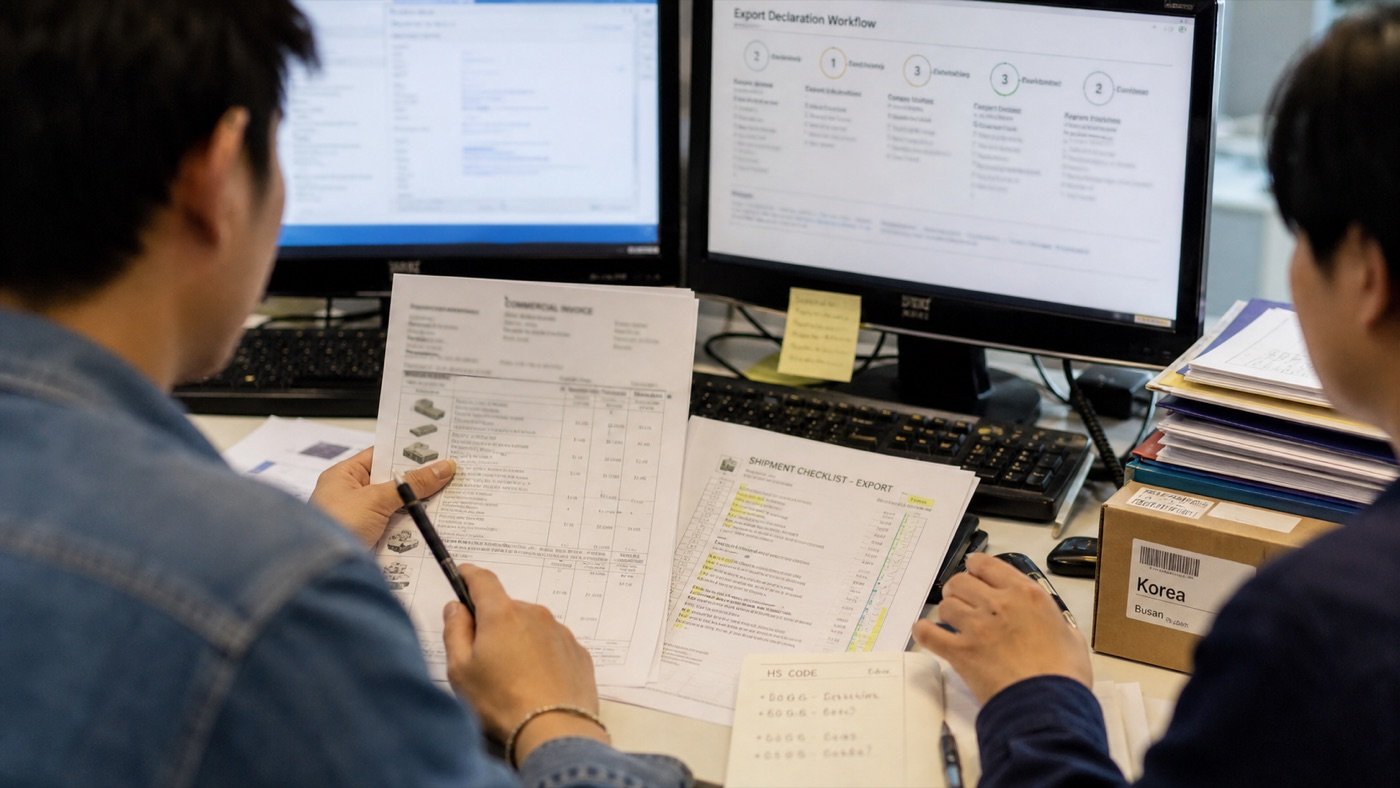
Step 4: Prepare China Export Documents
For general cargo, China export declaration usually starts with the commercial invoice and packing list. Hamjing reviews them against the actual cargo received at the warehouse, because a document can look complete but still fail operationally.
The document set may include:
Product value, buyer, seller, currency, Incoterm and product description.
Carton count, weight, measurement, package type and marks.
Product classification information for declaration review.
Port, vessel, flight, consignee and transport route.
Issued after shipment, used by the Korea-side broker for import clearance.
Battery paperwork, MSDS, certificate of origin, fumigation or inspection documents when required.
Document consistency matters. If the invoice says one product name, the packing list says another, and the HS code suggests a third category, the customs broker has to stop and clarify before filing. For China to Korea shipments, the cleaner approach is to correct this before cargo leaves the China warehouse.
Step 5: China Export Customs Declaration
Once the cargo information and documents are ready, the export declaration can be filed. The goal is to declare the goods accurately before they leave China.
Export declaration may be delayed if:
- The HS code is wrong or unclear
- The declared value looks unreasonable
- The product name is too broad
- The quantity does not match the packing list
- The supplier cannot provide required export information
- The cargo is selected for customs inspection
- The goods contain batteries, liquids, magnets, chemicals or controlled items
A forwarder should not simply say “customs is delayed.” The customer should know what is missing, who needs to provide it, and what action is being taken.
Step 6: Choose Sea Freight or Air Freight to Korea
China to Korea shipments usually move by sea freight or air freight.
Sea Freight
Sea freight is suitable for larger cargo, pallets, cartons and planned replenishment orders. Common trade lanes include Shanghai or Ningbo to Busan, Qingdao to Busan, Shenzhen or Guangzhou to Busan, and Tianjin to Incheon or Busan.
Sea freight can be arranged as FCL or LCL. FCL is better when the importer has enough cargo for a full container. LCL is useful for smaller shipments, but the importer should understand that CFS handling and warehouse handoffs create more document and milestone points than a direct full-container shipment.
Air Freight
Air freight is used for urgent cargo, high-value goods or replenishment shipments. It is faster, but the plan depends heavily on actual weight, volumetric weight, flight space and commodity restrictions.
Common airport routes include Shanghai Pudong to Incheon, Guangzhou to Incheon, Shenzhen or Hong Kong to Incheon, and Qingdao to Incheon.
What Happens When Cargo Arrives in Korea?
When cargo arrives in Korea, the Korean importer or appointed customs broker prepares the import declaration. According to Korea Customs Service, import clearance is handled through the UNI-PASS electronic system, and the declarant may be a customs broker or the owner of goods.
The Korea-side process usually includes:
- Arrival notice
- Document review
- Import declaration
- Customs risk screening
- Duty and VAT assessment
- Inspection if selected
- Customs release
- Local delivery
If customs asks questions, the broker may request product photos, catalogs, material details, certificate of origin, value explanation or additional compliance documents.

Documents Korean Importers Should Prepare Early
The Korean importer should not wait until the vessel arrives. Before the shipment leaves China, the importer should confirm:
- Korean importer business details
- Customs broker contact
- Product description in Korean if required
- HS code review for Korea import
- Commercial invoice
- Packing list
- Bill of lading draft
- Certificate of origin if needed
- Product certificates or test reports for regulated goods
- Final delivery address
- Duty and VAT payment arrangement
This is especially important for food, cosmetics, medical products, electronics, batteries, children’s products, chemicals, branded goods and textile products with labeling requirements.
Common China to Korea Customs Problems
1. Supplier gives estimated packing data
The supplier may provide carton size before final packing. After goods arrive at the warehouse, the real CBM is different, so the shipment plan has to be corrected before booking.
Better approach: measure cartons at the China warehouse before final booking.
2. Product description is too vague
“Gift item,” “accessory,” “plastic product” or “machine part” may not be enough for customs review.
Better approach: ask for material, use, product photo and HS code suggestion before declaration.
3. Exporter name does not match the documents
Sometimes the supplier is not the actual exporter. Another trading company may appear on the export documents.
Better approach: confirm exporter, invoice issuer and declaration party before pickup.
4. Korean importer is not ready
Cargo arrives, but the Korea customs broker has not received the invoice, packing list or bill of lading. This can create storage and local delay.
Better approach: send documents to the Korea broker before departure or before arrival.
5. HS code disagreement
The China export HS code and Korea import classification may not be treated exactly the same in practice.
Better approach: use China-side product data for export declaration, but let the Korea-side broker confirm the Korea import classification and duty rate.
Case Study: How Hamjing Helped a Korean Customer Ship From China to Korea
A Korean customer contacted Hamjing after buying household storage products and ecommerce inventory from three Chinese suppliers in Shenzhen, Dongguan and Yiwu. The customer had shipped small orders before, but this shipment was different: more cartons, more suppliers, and a Korea-side customs broker asking for cleaner product descriptions before arrival.
The customer sent Hamjing supplier contacts, product photos, a draft invoice from each supplier, packing data and a Korea delivery address. The first thing we noticed was that the suppliers were using different product descriptions for similar goods. One supplier wrote “daily use goods,” another wrote “storage box,” and the third used a Chinese product name translated too broadly into English.
Shipping separately would have created three problems:
- Three separate pickups
- Three separate LCL movements
- Three sets of document review work for the Korea-side broker
Hamjing suggested consolidating everything at one China warehouse before export, then preparing one cleaner document package for the Korea-side broker.

Step 1: Supplier delivery plan
We gave the customer one warehouse address and asked each supplier to mark the cartons with the Korean customer’s reference number. Before delivery, we collected supplier contacts, cargo ready dates, carton quantity, product names, invoice details and photos of the outer cartons.
Hamjing also made a receiving list for the warehouse team. Each supplier was assigned a simple reference, so when cartons arrived, the warehouse could match them to the correct supplier instead of only relying on Chinese company names or handwritten marks.
Step 2: Warehouse receiving and carton check
When the goods arrived, the warehouse checked the carton count against the packing list. One supplier declared 42 cartons, but only 40 cartons arrived. The warehouse reported it immediately with receiving photos and the packing list comparison. The supplier found the two missing cartons and delivered them the next day.
This is a small detail, but it is exactly where many Korea shipments become messy. If the missing cartons are discovered after export, the customer either ships them separately later or has to explain a document mismatch to the broker. Catching it at the China warehouse kept the shipment clean.
Step 3: Measurement and consolidation
After all cartons arrived, the warehouse measured the shipment again. The final CBM was different from the supplier estimate, so the booking plan was updated before cargo was handed to the carrier. The customer received receiving photos, carton count summary, final measurement and an export document checklist.
Hamjing then grouped the cartons by supplier and product type, checked whether any carton marks were unclear, and confirmed whether the customer wanted the goods shipped as loose cartons or palletized cargo. The decision was made before export, not during destination handling.
Step 4: China export declaration
Before declaration, Hamjing reviewed the invoice and packing list. Two product descriptions were too broad. Instead of “household item,” the document was revised to “plastic storage box for household use.” This made the export declaration clearer.
We also checked that carton count, gross weight and product lines matched between the invoice and packing list. Where the supplier’s invoice was missing material information, we asked for confirmation before filing. The customer could see what was changed and why, instead of receiving only a vague “documents updated” message.
Step 5: Sea freight to Busan
After export release, the cargo was arranged as one LCL sea shipment to Busan. We shared the sailing schedule, bill of lading draft, final invoice, packing list and tracking updates with the customer.
The bill of lading draft was checked before release, including shipper, consignee, notify party, cargo description and package count. This helped the Korea-side broker prepare with the same information that appeared on the shipping document.
Step 6: Korea import clearance
The Korean customer sent the documents to their Korea customs broker before arrival. Because the invoice, packing list and product descriptions had already been checked in China, Korea-side clearance moved without a major document delay.
Hamjing’s role during Korea clearance was coordination: we supplied the shipping documents, answered document questions from the customer, and kept the customer updated on arrival and release milestones. The Korea-side customs broker handled the local import declaration, duty and VAT process with the importer.
What the customer actually received from Hamjing
For this shipment, Hamjing did more than book space. The customer received a practical operating package that could be shared internally and with their Korea-side broker:
- A supplier pickup and warehouse delivery plan
- Warehouse receiving photos for each supplier
- A carton count comparison against supplier packing data
- A missing-carton notice before export
- Final measurement after all cargo arrived
- Cleaned product descriptions for export documents
- Commercial invoice and packing list review before filing
- China export declaration coordination
- LCL shipment arrangement from China to Busan
- Bill of lading draft review before release
- Document handover support for the Korea customs broker
- Milestone updates from warehouse receiving to Korea arrival
The important point is control. The customer did not have to chase three suppliers, one warehouse, one carrier and one Korea broker separately. Hamjing organized the China-side information into a shipment file that the customer and the Korea-side broker could actually use.
Where Hamjing draws the line
For transparency, Hamjing does not present Korea import declaration as a China-only task. Korea import clearance belongs to the Korean customs process and normally requires the Korean importer or an appointed Korea customs broker. Hamjing supports that process by making the China-side cargo data, transport documents and export information clear before arrival.
Practical Timeline for China to Korea Shipping
| Stage | What happens | Risk if not ready |
|---|---|---|
| Day 1-2 | Supplier pickup or warehouse delivery | Unmarked cartons or missing supplier details |
| Day 2-3 | Warehouse receiving, measurement and photos | Booking details no longer match real cargo |
| Day 3-5 | Booking and export document review | HS code or invoice mismatch |
| Day 5-7 | China export declaration and loading | Customs inspection or missed cutoff |
| Arrival in Korea | Import declaration, duty/VAT, release | Terminal delay if broker lacks documents |
These are practical estimates, not guarantees. Customs inspection, port congestion, vessel changes, regulated products or missing documents can change the timeline.
What Hamjing Checks Before Shipping China to Korea
For Korea shipments, Hamjing checks the supplier pickup plan, warehouse receiving status, carton count, measurement, shipping marks, commercial invoice, packing list, product description, HS code information, export declaration readiness, vessel or flight schedule, bill of lading draft, Korea broker document requirements and final delivery plan.
This does not replace the Korean importer’s customs broker. It makes the Korea-side work cleaner because the documents are reviewed before arrival.
FAQ
Can Hamjing handle both China export declaration and Korea import clearance?
Hamjing can coordinate China export declaration, shipping, document preparation and Korea-side communication. Korea import declaration is usually filed by the Korean importer or their customs broker. For door-to-door shipments, Hamjing can help coordinate the full route with local partners.
What documents are needed for Korea customs clearance?
Common documents include commercial invoice, packing list, bill of lading or air waybill, import declaration and any certificates required for the specific product.
Should the Korean importer confirm the HS code before shipping?
Yes. The China export HS code and Korea import classification should be reviewed before shipment, especially for regulated or high-duty goods.
Can several Chinese suppliers be combined into one Korea shipment?
Yes. Consolidation is one of the best ways to reduce LCL handling and simplify import documents when buying from multiple factories.
What causes Korea clearance delays?
Common causes include unclear product descriptions, missing invoice or packing list, HS code questions, unpaid duty or VAT, inspection selection, regulated goods without certificates, or importer/broker not ready before arrival.
Is DDP shipping to Korea possible?
It may be possible for some goods and routes, but DDP should be used carefully. The importer should understand who is responsible for import declaration, duty, VAT, compliance documents and final delivery.
Conclusion
China to Korea shipping is usually manageable when the shipment is prepared properly. The real work happens before the cargo leaves China: confirming the importer and Korea broker, receiving and measuring the goods correctly, cleaning up invoice and packing list details, using accurate product descriptions, preparing export declaration documents and sharing documents before Korea arrival.
A short route still needs a disciplined process.
Need help planning a China to Korea shipment?
Send Hamjing your supplier city, product name, carton quantity, dimensions, weight and Korea delivery address. We will review the route, documents and customs clearance plan before cargo moves.
Sources
Need a freight quote from China?
Send Hamjing Logistics your route, cargo details and preferred delivery plan. Sally will review the shipment and reply with the next steps.
Request a quote